


Topping DX1 II — A Wannabe Desktop DAC/Amp That Never Truly Leaves USB Dongle World - Honest Audiophile Impressions


Topping has been a staple in the audiophile community ranging from budget friendly to not‑so‑budget friendly products. They have released another budget friendly DAC/Amp: the DX1 II. This is a revision of the DX1 that I haven’t had the opportunity to use. But over the years of reviewing I have heard many Topping products, so I am familiar with the brand. So let’s take a look at this new DAC/Amp offering.
The Topping DX1 II will set you back $120 from your bank account. This places it solidly in the budget category.
I want to thank Shenzhen Audio for providing the Topping DX1 ii for review, much appreciated.
Purchase: https://shenzhenaudio.com/products/topping-dx1-ii-es9039q2m-desktop-dac-headphone-amplifier-1
More Information:
Glancing through the numbers, the Topping DX1 ii has all the markings of something special BUT is it?
SPECS:
TLDR version:
ESS ES9039Q2M DAC architecture
Four-channel fully-balanced amplifier design
Up to 1000mW x 2 at 32Ω through 4.4mm output
Measured THD+N as low as 0.000056%
SINAD reaching approximately 125dB
Signal-to-noise ratio up to 128.8dB
Dynamic range up to 128.8dB
Ultra-low noise floor below 0.9μVrms
USB-C connection carries power and audio
Infrared remote included
Seven digital filter modes
PCM 384kHz and DSD256 support
Optical input and output support
Front display with gain and status indicators
Full Spec Breakdown:
DAC chip: ESS ES9039Q2M
USB processor: XMOS XU-316
USB audio mode: UAC1.0/UAC2.0
PCM support: Up to 384kHz
DSD support: DSD256
Balanced output power: 1000mW x 2 @32Ω
Balanced output power: 1000mW x 2 @64Ω
Balanced output power: 230mW x 2 @300Ω
THD+N: 0.000056% minimum measured
SINAD: Up to 125dB
Signal-to-noise ratio: Up to 128.8dB
Dynamic range: Up to 128.8dB
Balanced output level: 5.1Vrms @0dBFS
Balanced headphone output level: 8.3Vrms measured
Channel crosstalk: -140dB @1kHz
Noise floor: Below 0.9μVrms
Frequency response: 20Hz–20kHz (±0.1dB), 20Hz–40kHz (±0.3dB)
Dimensions: 3.9 x 3.9 x 1.3 in (10 x 10 x 3.2 cm)
On paper, the DX1 II looks like a budget giant-killer but specs don’t tell the whole story. Let's see how this story plays out; do we have a hero or a zero?
Box & Contents

The Topping DX1 II comes in a black box with Topping spelled out in silver on the top.

Removing the top lid you find a foam insert cradling the Topping DX1 II, a multi‑button remote and two USB cables.

The cables are quality built, rubber with a firm termination support. One cable is USB‑A to USB‑C and the other is USB‑C on both ends.
Overall, the cables are very nice but a tad long if you are using the DX1 II in a portable setting.

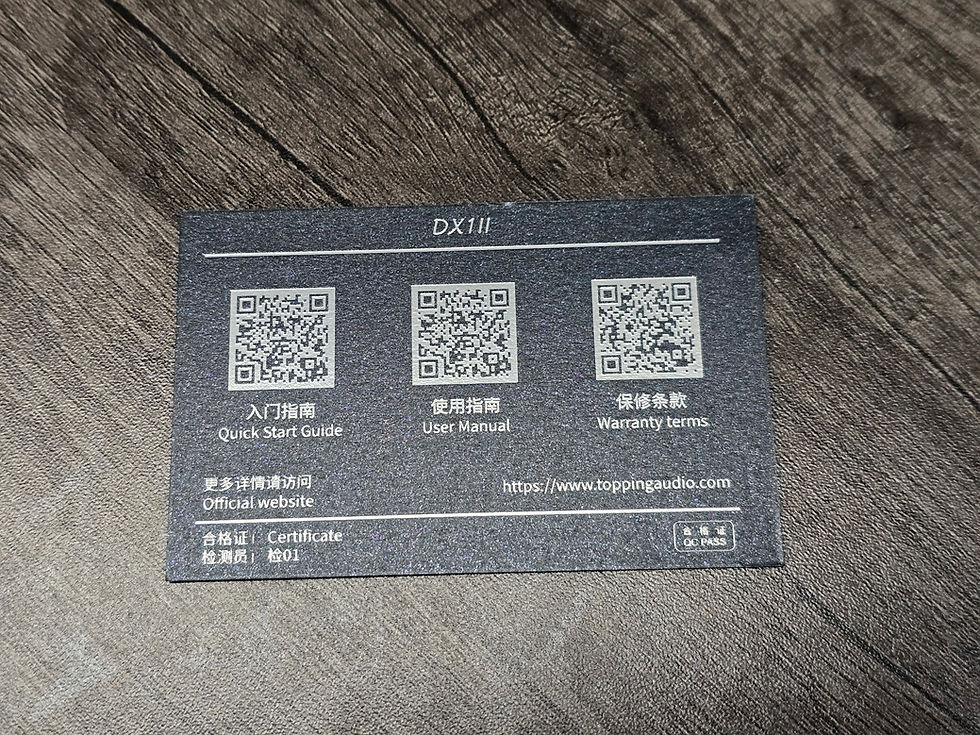
The warranty card is....nice.


The remote is a typical feeling and looking remote from Topping. The buttons are well laid out, responsive and intuitive. With the remote you can switch gain modes, EQ profiles, inputs, and other settings.
The remote comes in handy to swap inputs, gain and filters; something that isn’t as easy using the multi‑function volume control.
Build/Design
The DX1 II has the usual Topping build and design: compact, clean, and functional rather than flashy.


Its CNC‑machined aluminum chassis feels solid, and the unit is powered entirely over USB‑C.


The display shows volume, input, gain, and PEQ status. The 3.5mm jack supports both conventional headphones and TRRS headsets with microphone input, while the 4.4mm balanced offers the most output power.


On the backside you find USB‑C, optical input/output, RCA output, and a 4.4mm balanced line output. The small size is perfect for a compact desktop setup or even a portable/on‑the‑go one.


Ohh… there is a Hi‑Res sticker so it’s got to sound good!
Inputs/Outputs
The inputs are USB‑C and optical. I only used USB‑C connected to my MSI laptop and the PlayStation PS5. The DX1 II utilizes USB UAC1 and UAC2 so it is compatible with most modern gaming systems.
I found it easy to use; there is a switch on the back to choose between UAC1 and UAC2.
A thing of note: the Topping DX1 II wasn’t able to be powered by my Samsung S24 Ultra; it only worked with my laptops and gaming consoles.

The RCA output was easy enough to connect to external amps like the Mytek Liberty THX AAA HPA and SMSL HO150x. Sound wise it was just like the headphone output.

Speaking of the headphone outputs, the 3.5mm single‑ended is severely underpowered. The 3.5mm works adequately for IEM and very easy‑to‑drive headphones. The 4.4mm balanced has significantly more power and can drive a broader range of headphones, but don’t count on it powering demanding planars or 300‑ohm Sennheisers optimally. The other thing of note is that the 4.4mm output sounds cleaner and more accurate than the 3.5mm.
Power:
Overall, the Topping DX1 II is more like a modestly powerful, oversized USB‑C dongle with extras. Power isn’t on the same level as a desktop, but on balanced output is similar to some higher‑end USB‑C dongles.
The DX1 II works best with IEM and the balanced output. Headphones are hit and miss, and as long as you use easy‑to‑drive headphones that don’t require a lot of watts, voltage, and current you should be okay — but it will not be powering your planars or 150‑ohm headphones optimally.
I found that I ran out of room on the loud knob often, getting upwards to –33 dB on high gain more often than not with 300‑ohm Sennheiser and planar headphones. So even though it will get most headphones loud, it doesn’t drive them accurately with their usual dynamics and clarity.
I tested the DX1 II with a variety of IEM and headphones. IEM of note are the Unique Melody Stardust, SoftEars RSV MKII, Kiwi Ears Astral, Meze ASTRU, Kiwi Ears Orchestra II, ThieAudio Oracle MK3, DUNU DN242, Westone Mach60 and Tanchjim Origin. Headphones tested were the Sennheiser HD660S2, Sennheiser HD580 Precision, MrSpeakers Ether C, Moondrop Para, Harmonicdyne Romantic, Austrian Audio Hi‑X60, ZMF Eikon and Audeze LCD‑5.
Filters
To be completely honest, I didn’t hear any noticeable differences between the filters. This is something I find common among budget DAC/Amps and the DX1 II is no different.
Sound Impressions
So how does the Topping DX1 ii sound?
Bass
Outlined but not physical. You get the shape of bass notes, but not the weight behind them. Mid‑bass warmth is held back, even on headphones that normally carry it. Cello, bass lines, and low‑end pulses become contour without body. When using headphones, the bass driver never feels fully energized, even on balanced output; this isn't as noticeable with IEMs.
Mid Range
Clear but thin. Presents information, but not the density or mass of real instruments. Midrange warmth is stripped away; everything feels skeletal. Piano loses hammer weight; strings lose resonance. The DX1 II gives you the attack but not the instrument behind the attack.
Treble
Glassy, glaring, metallic. Upper frequencies have a sheen that feels more like a hard edge than real air. Treble is clean but lacks natural decay and shimmer. It emphasizes the outline of transients rather than the texture. Extended, but not refined — clarity without realism.
Technical Abilities
Stage
Wide but shallow. Left/right placement is present, but front/back depth collapses. Everything sits on the same horizontal line.
Depth
Minimal. Ambience retrieval is weak; room cues are flattened. Instruments lose their physical space.
Layering
Slightly compressed. The DX1 II stacks information rather than separating it. Complex passages become a wall of sound.
Imaging
Accurate but not dimensional. You can tell where things are, but not how far away they are. No sense of height or depth — only width. You can track details from side to side but it isn't the most pin-point accurate.
Detail Retrieval
Information without conviction. Details are audible, but not embodied. You hear the edges of notes, not the substance.
Resolution
Competent but emotionally flat. It resolves the music, but doesn’t translate the life inside it. Micro‑dynamics are muted; macro‑dynamics are compressed.
Tone
Neutral‑cold, analytical. Clean but lacking warmth, weight, and natural fullness. Everything feels slightly dehydrated — the tonal skeleton without the flesh and muscle.
Timbre
Correct but incomplete. Instruments sound like themselves, but without their physical presence. Piano becomes percussive without body; strings become etched without bloom. The DX1 II delivers timbre information, but not timbre realism. Comparisons:
I honestly don’t have anything around the office currently that compares directly to the Topping DX1 ii. So I am going to compare it to two portable DAC/Amp that I use often, the SMSL DS20 and Questyle Sigma.
SMSL DS20:
The DS20 is a thinner rectangular shape with a glass top giving a view of the board inside. The DX1 ii is thicker, heavier and looks more like a desktop device. The DX1 ii has more options like line out RCA, display screen and a large volume knob.
But when it comes to sound reproduction the SMSL is superior in my opinion with its neutral, analytical presentation that includes a natural warmth and body that resembles real like qualities of voice and instruments. The DS20 is also better with its staging depth, layering and imaging. Tone and timbre are more natural and accurately defined.
When it comes to output power, the DS20 is excellent with any IEM and it is lacking the power to push harder to drive headphones but is adequate with easier to drive gear. The edge with driving headphones goes to the Topping.
Yes, the DS20 is pricier but to me it is the better option even if it isn’t as powerful on paper.
More Information:
https://www.smsl-audio.com/portal/product/detail/id/913.html Link to my review of the SMSL DS20:
Questyle Sigma:
The Sigma is smaller and pocketable, with a beautiful rounded case and glass top showing off the board and lights. The Sigma has a lot of output capabilities similar to the DX1 ii but no RCA line out.
The ability to run off battery or be charged while in use is a nice feature.
Sound presentation is where the Sigma blows the DX1 ii out of the water. The Sigma has a natural, neutral, analytical presentation that is top of the line for a portable DAC/Amp. The Sigma is a major upgrade over the Topping in every area of sound, dynamics, detail retrieval, resolution, width, depth, layering, tone, timbre.
Output power is also a big step up with 1200mw of power and the ability to drive those harder to drive planar and dynamics better.
Yes, the Questyle Sigma is more expensive but in my honest opinion it is well worth the extra price for what it offers sonically.
More Information:
Link to my review of the Questyle Sigma: https://youtube.com/live/ZmOOVugaHBw
Gaming: I tested the Topping DX1 ii with the Playstation 5. Please note, I am a solo gamer who focuses on sim racing and sports games and does not voice chat.
I played NCAA 26, Assetta Corsa Competzione and FIFA 25 among others and found the Topping DX1 ii to be a competent gaming DAC/Amp.
I enjoy gamiing with an IEM so the DX1 ii fit in perfectly for my gaming preferences. I found the staging to be adequate and immersive for my limited gaming title needs. I was able to place competing cars around me accurately and hear my cars brakes, tires and my spotter/crew chief well. In sporting games the crowds were immersive and teammates calling for the ball and other on field noises were well placed.
Overall, I found the experience to be enjoyable for a casual gamer like me.
Conclusion:
The Topping DX1 ii isn’t going to replace my current reference desk setup of the Mytek Liberty DAC ii and Mytek Liberty THX AAA HPA nor is it going to replace either of my portable references; SMSL DS20 or Questyle Sigma.
BUT I could see it being used by someone who does a lot of traveling and wants a simple plug-n-play DAC/Amp for casual gaming and music enjoyment. Or for someone who is starting out and wants a budget friendly introduction into the world of neutral, analytical sound and easy to drive IEM and headphones.
BUT the Topping DX1 ii isn’t for someone looking for a reference sound or to drive power hungry headphones.
If you are a casual gamer and don’t like the sound of your TV speakers and want something more competent, the Topping DX1 ii is an excellent choice for those casual gaming moments.
For what it is, the Topping DX1 ii is good but nothing special. It is a wannabe, glorified USB-C dongle that is underpowered and has a very analytical, sterile approach.
I can’t say I truly enjoyed the experience but I didn’t dislike it either but the Topping DX1, isn’t for me. For what it is, the DX1 II is fine but it never truly leaves USB dongle territory nor does it enter the portable DAC/Amp landscape .
I am Dave the Honest Audiophile. Thanks for reading, and I will catch you in the next one.
Stay grounded. Stay curious. Enjoy the music.
And remember: Honesty is the Best Policy.
Thanks for Reading
If you're into honest, no‑hype audiophile content, hit Subscribe and tap the 🔔 so you never miss a new video.
Enjoyed this one?
Give it a thumbs up — or a thumbs down if you didn’t. Either way, I appreciate the feedback.
🗣 About Me
I’m not a professional sound engineer, producer, or musician. I don’t do lab measurements or scientific testing. Everything I share comes from real‑world listening, personal comparisons, and a whole lot of reading and research.
I’ve volunteered as a sound tech in churches since my teens and have dabbled with recording, mixing, and mastering gear. These are simply my honest impressions — one audiophile’s perspective, shared with clarity and respect.
🛠 Quick Note About My Workflow
I write all my own impressions and evaluations. I use AI‑assisted editing tools only to help clean up wording and keep things clear, but every opinion and conclusion comes from my own listening and experience.
🌐 Connect With Me
Instagram: @thehonestaudiophile
Twitter: @TalkDbs
Discord: https://discord.gg/ZveuNxKxXY
Website: https://thehonestaudiophile.com
📚 Learn More
Audio Terms & Definitions: https://www.thehonestaudiophile.com/post/the-honest-audiophile-s-terms-and-definitions-guide
Reference Music List: https://www.thehonestaudiophile.com/post/my-reference-music-tracks-2025-expanded-list
Tier List Rankings: https://www.thehonestaudiophile.com/post/another-tier-list
TIDAL Playlist: https://tidal.com/playlist/0a5604d1-f09e-47f3-9f77-f07efe926221
🎧 Recommended Gear
Audeze LCD‑5
Audio‑Technica R50x
Audio‑Technica R70x
Austrian Audio Hi‑X60
Audeze LCD‑2 Closed Back
Westone Mach 60
Mytek Liberty DAC II
Mytek Liberty THX HPA
DROP SMSL HO150x
DROP THX AAA One Linear
💡 Support the Channel
If you enjoy the content and want to help keep it going, consider supporting the channel. Every bit goes toward bringing in more gear for honest reviews.
PayPal: https://www.paypal.me/dbsylvia
Venmo: @David-Sylvia-6
Join the Channel: https://www.youtube.com/channel/UCgMj7xJ1SDxGqqxZ5l3g_jg/join
📬 Contact: dbstechtalk@gmail.com
🛒 Affiliate Links
Drop: https://drop.com/home?ranMID=50354&ranEAID=4pEFW3GzSkg&ranSiteID=4pEFW3GzSkg-qiY5vnpC3ls1112R8CFKog
Apos Audio: https://apos.audio?sca_ref=45218.8XN5h6dArS

good to know. they are now selling a cable to separate between power and data, do you think it will help or not?